
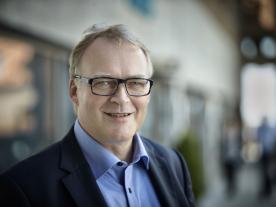
OWI: Hardly a large trade fair goes by without Siemens Gamesa presenting a product innovation for the offshore wind sector. How do you perceive the innovation pressure for Siemens Gamesa?
Bent Christensen: We are not alone with this pressure: The entire offshore industry is running through a rapid development to meet cost-out targets. With the low bids for projects in Denmark and the Netherlands and zero-bids for German projects, this race has been further accelerated. But we are also proud to drive a technology with such an outstanding success story in fast development.
OWI: Has the pressure changed in recent years?
Christensen: Some years ago, we set ourselves ambitious cost-out targets with an LCoE of 10 ct/kWh by 2020, and now we are running ahead of this goal. The momentum in offshore wind is driven by new opportunities and options that are discovered with every milestone we reach. In this context, the most important change in recent years was the awareness that we have now really arrived in the league of main technologies for the future energy supply.
OWI: What impact does competition have on the pace of development?
Christensen: The consolidation processes of the last years clearly show that a certain size is vital to survive in this competitive environment. Only a highly industrialised company will be able to overcome the challenges of the changing market environment. There will also be a highly competitive situation in the future – but the number of players is decreasing. Also the market regimes in several European countries with auction models are a strong trigger for cost reduction through innovations. Now that we see offshore wind becoming a central energy source in only a few years ahead of us, this is a kind of final sprint for all the players in the market. So my prediction for the next decade is that we will have to keep up the pace of development that we are currently seeing.
OWI: Siemens stopped the sale of the 7-MW plant in favour of the 8-MW plant last year, before the first 7 MW plant had even been built. New products are launched on the market before existing ones can deliver long-term experience. Isn’t that an immense risk on the technical side?
Christensen: First of all our customers can select the best turbine for their site specific wind conditions between all ratings of our Direct-Drive Offshore platform. In addition to comprehensive testing, this platform strategy is precisely what ensures the reliability of our products. By retaining most of the components and improving what is necessary to enhance the output, we make sure that the long term experience is incorporated in the genetic code of our products. That is how we connect innovation and evolution in our product development.
OWI: Wouldn’t it be more effective in the end to do fewer but higher jumps?
Christensen: No, there is a learning curve but not a learning staircase for this kind of technological development. Supply chain, substructures, logistics, installation processes and many more elements involved in building and operating offshore wind projects must grow in a synchronised manner. The steps we currently take in higher-rated offshore wind turbines allow the entire industry to mitigate risks and develop by learning.
OWI: In the Nissum Bredning Project, Siemens wants to test new technologies. Which turbine will we see used there?
Christensen: We will install the first serial-built SWT-7.0-154, but this is only one part of the project’s innovations: It will be installed on our gravity jacket foundation that can be assembled with standard steel pipes and robot-welded nodes. The design can be seen as a universal toolkit to build jacket foundations for different water depths.
OWI: Are foundation manufacturers so behind in the area of innovations that Siemens as a turbine manufacturer must also be active in this field?
Christensen: This is not meant as criticism of the colleagues at the foundation manufacturers but rather as a proposal for future concepts. Since the turbine counts for less than 30 percent of the offshore wind LCoE, it is quite natural that we also take other elements of the supply chain into consideration. At Nissum Bredning we will also be using our cable-in-pipe concept, which allows us to use cheaper onshore cables by placing them in plastic pipes. But this is not an attack on cable suppliers, we are simply testing a new idea.
OWI: The foundations of the Danish wind park Vindeby, which was the first offshore wind farm in the world, are currently being disassembled. As one of the original turbine suppliers, how satisfied are you when you look back on the project?
Christensen: This project makes us all very proud. With 25 years in operation, Vindeby has shown proof that offshore wind is reliable and sustainable. In the meantime we have learned so much, we have improved our technology and provide turbines that are nearly 20 times larger in rating and size. But the first experiences we gained with this first commercial offshore park are still in our minds when we do our work.
OWI: What is the most important lesson learned for you?
Christensen: That the codes and standards used for the design of main components, corrosion protection and so on were sufficient. The turbines were designed for a service life of 20 years, and they were in operation for more than 25 years with high reliability.
OWI: With the decommissioning of Vindeby, the offshore wind industry is once again breaking new ground. How is Siemens Gamesa involved in this process?
Christensen: After decommissioning, we will have a closer look at the condition of the main components after 25 years of wear and tear to see what we can learn to help to optimise current components.
The interview was conducted by Katharina Garus
Fuente: http://www.sunwindenergy.com/
Publicar un comentario